Mostrando entradas con la etiqueta Polyhedra. Mostrar todas las entradas

2 feb 2023

Science food: Sugar polyhedra

3D printing was proposed around 1981 when the first patent for a printer of this type was registered in Japan, but it was not until 1984 when the American inventor Charles Hull made the concept of three-dimensional printing a reality.

3D printing, however, did not become popular until the 21st century. Today, a 3D printer can print impressive models using plastic filaments deposited by layers.

However, can a 3D-printer print food?

13 jul 2018

And suddenly, you look out...

A face appears on the bright screen of a computer as if it was the same. But its heart has stopped beating. - It is asleep - is the thought of the most optimistic people. One of those days it will be reborn in the light of a new technology. But the pessimists think that its digital life has gone forever.

The files collected in many navigations trough strange seas in a world parallel to the human one. Images and written documents whose content may never will be read again. There is a mourning  when someone dies. It lasts months and sometimes even years ... sometimes a whole life. But what happens when the virtual life disappears? The loss is different from facing. It's hard but strange to know what happened when you felt something so alive and suddenly dies but it was not alive actually.

A failure of the electric light like a shock that accelerates the heart rate and suddenly stops it. A fall that destroys everything. A hard disk that exists but at the same time disappears. The information contained among its clues: disappeared forever ... or perhaps it is asleep.

And suddenly, you look out, small piece of geometric symmetry, as if to say that you are still alive.


25 feb 2016

Mad about polyhedra III

In this virtual or real world, there are so many people and so many stories.

A certain day, the artist Dan Sternof decided to discover a wood dodecahedron inside a tree trunk in front of his house. When the winter had come, he decided to leave snow dodecahedra to improve the city landscape!


14 ene 2016

The caged polyhedron

The ideas were coming to my mind as rolling spheres.
But the spheres became cubes as the ice cubes that are stored in the fridge, waiting.

The time ran and ran too fast. The seconds became minutes and hours in a 19-hours day that lasted an instant and a 5-hours insomnia night fighting to rest.

Writting became a necessity and an impossible task. One day after another. The months passed with other thoughts in the mind. The polyhedron was stored in a box over the vitrine full of dusty glasses. Sometimes there was a bright ray in the box and some words used to fall as water drops. But the polyhedron remained caged because the glass remained empty.

Fortunately, this is a rolling world that let me to clean the glasses and the ceramic figures shining with the sun.


I have put the polyhedron out of its box waiting the it can be outside for a while…

7 nov 2014

Mad about polyhedra II

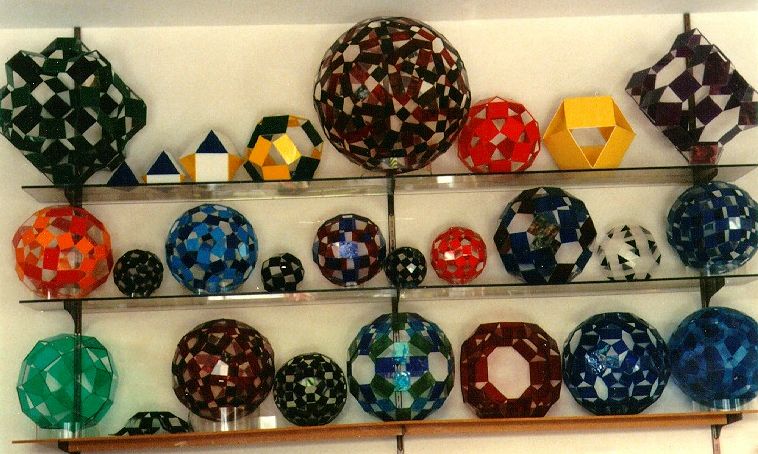
In the childhood we learn about some simple 3D geometric figures like de pyramids and prisms. Even most of us build our own polyhedron shapes for homework in the primary school. However with the time, most of the people forget the existence of polyhedra. But it happens that one day in certain moment due to a strange cause you will find again a polyhedron and you will not let it go.
This situation happened to the chemist engineer Henry Chasey who decided to build its own fantastic polyhedra after seeing the Kepler’s platonic model in Carl Sagan’s Cosmos tv program. Therefore, since the 1980’s, Chasey built a huge collection of melted acrylic polyhedra.


8 jun 2014

Mad about polyhedra I

There are people in this world who do not know polyhedra yet.
But, on the other hand, there are people who someday know polyhedral and after this moment they will never let them go…

10 oct 2011

The first polyhedron in soccer football

The history of the Soccer World Cups began in 1930 when the first World Cup was carried out in Uruguay, host country and first champion. The rules of this sport were established in England at the end of the XIX century. Since then, the ball was made of leather clusters joined by hand.

The form of the traditional ball changed at the beginning of the 70s when a new geometric model revolutionized the history of this sport.